How many hours a day do you spend looking at your phone screen? If your answer is “a few hours,” you’re not alone. But the part of your body that pays the highest price for this seemingly harmless habit is the most strategic and sensitive point of your spine: the Atlas (C1) bone.
This condition, frequently referred to in the literature as “Tech Neck,” is not just a simple muscle strain; it is a structural problem that disrupts the natural architecture of your spine. So what actually happens in the body when our head shifts forward, which subtle complaints does it trigger, and how can Atlas Therapy break this chain?
The Invisible 27-Kilogram Load
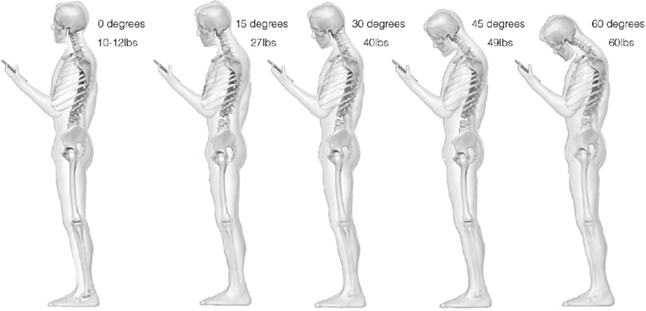
Under normal conditions, an adult human head weighs approximately 4.5–5 kg. When the natural “C”-shaped curve (lordosis) of the neck is preserved, the cervical vertebrae carry this load effortlessly, like a spring system. However, according to a striking study by Hansraj (2014), when we tilt our head forward to look at our phone, the laws of physics start working against us.
With every degree the head tilts forward, the torque force and load on the neck increase exponentially:
-
0 degrees (Neutral): 5 kg load (natural weight)
-
15 degrees tilt: 12 kg load
-
60 degrees tilt: 27 kg load!
This is equivalent to carrying an 8-year-old child on your neck all day long. To cope with this massive load, the back muscles remain constantly contracted (protective spasm), and over time the spine changes shape, evolving into a permanent postural disorder known as Forward Head Posture (FHP).
The Domino Effect: It’s Not Just “Neck Pain”
Although most patients come to us complaining only of neck pain, Forward Head Posture and atlas dysfunction create a domino effect throughout the body. The atlas bone acts like a “narrow bridge” for the nerves exiting the spinal cord and the vessels supplying the brain. Compression or postural imbalance here can lead to unexpected side effects:
-
Temporomandibular Joint (TMJ) Problems:
Biomechanically, when the head moves forward, the lower jaw shifts backward. This causes tension in the chewing muscles, nighttime teeth grinding (bruxism), and clicking sounds in the jaw joint. -
Numbness and Tingling in the Hands:
Excessive tension in the neck muscles (especially the scalene muscles) can compress the nerve bundle going to the arms, resulting in numbness and weakness in the fingers. -
Reduced Breathing Capacity:
Forward head posture closes the rib cage. Studies show that individuals with FHP cannot fully use their diaphragm and tend to breathe more shallowly—often the hidden cause of chronic fatigue. -
Hump Appearance (Dowager’s Hump):
To compensate for the head’s weight, the body accumulates fat and connective tissue at the junction of the neck and upper back (C7–T1), forming a hump-like appearance. -
Brain Fog and Concentration Problems:
A positional fault of the atlas bone can affect blood flow to the brain, even at a millimetric level. This can lead to the feeling of “my head feels full” and reduced focus.
The First Step Toward a Solution: Atlas Therapy and Proper Mobilization
The good news is this: tech neck and the chain of problems it creates are not your destiny. While muscle relaxants only suppress symptoms, Atlas Therapy targets the root cause—the biomechanical alignment.
You can’t open a locked door by forcing it; you need the right key. In our approach, instead of forceful manipulations, we use gentle mobilization techniques with proven effectiveness in the literature (such as the Maitland concept).
The therapy process aims to:
-
Free the Atlas:
Restore mobility at the key junction between the skull and spine (the C0–C1 joint). -
Calm the Nervous System:
By relieving pressure on the vagus nerve, the body shifts from “fight or flight” into a relaxed state. -
Balance Load Distribution:
Reduce the virtual 27-kg load back to the natural 5-kg weight.
What You Can Do to Support the Therapy
For professional atlas therapy to have lasting results, daily habit changes are essential. Here are some golden rules to protect your spine:
-
The “Chin Tuck” Exercise:
One of the most effective movements you can do frequently during the day. Without tilting your head forward, pull your chin straight back as if trying to touch the wall behind you (like making a double chin). This lengthens shortened neck muscles and repositions the head over the spine. -
Change the Rule:
Don’t hold your phone at chest or lap level. Raise it to eye level. Adopt the principle:
“The phone should come to me; I shouldn’t go to the phone.” -
Choose the Right Pillow:
Your neck should not be left unsupported while sleeping. Orthopedic visco pillows that support the cervical curve (lordosis) and are not too high allow the atlas to rest throughout the night. -
Micro Breaks:
If you work at a desk, every 30 minutes roll your shoulders backward and gently stretch the front of your neck by looking up toward the ceiling.
Remember: your spine is your tree of life, and the atlas bone is the root of that tree. Instead of waiting for pain to become chronic, having your posture and spinal health checked by professional hands is one of the greatest investments you can make in your future.